
In the field of water treatment, bag filter has become a key equipment in the industrial, agricultural and municipal fields due to its high flow rate, low cost and high dirt-tolerant capacity. This article systematically analyzes the working principle, core advantages, selection strategy and industry applications of bag filter, and provides full-link solutions based on authoritative data and cases.
I. What is a bag filter?
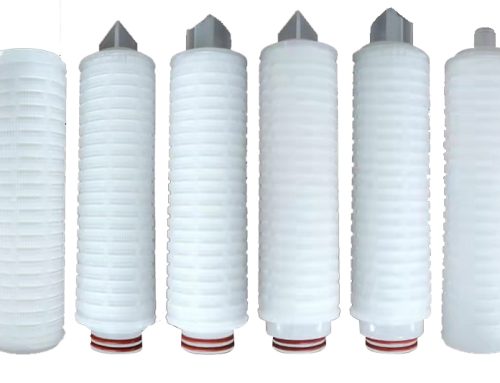
Bag filter is a kind of physical filtration equipment that intercepts suspended particles in water through porous filter bag, and its core is composed of filter bag and shell. Filter bag materials include polyester (PE), polypropylene (PP), nylon (NMO) and polytetrafluoroethylene (PTFE), with a pore accuracy of 0.1 to 500 microns, which can be adapted to different particle retention needs. Compared with the traditional cartridge, bag filter unit area processing capacity increased by 5~10 times, and supports repeated cleaning and use, reducing the comprehensive cost by more than 30%.
II.The working principle of bag filter
- Physical retention mechanism: water enters the filter from the top or the side, and when it passes through the filter bag, the particles are blocked in the bag, and the clean liquid flows out from the outlet.
- Multi-layer filtration design: the needle felt filter bag adopts a deep filtration structure, large particles are retained in the surface layer, and small particles are embedded in the fiber gap, which improves the dirt holding capacity.
- Dynamic pressure resistance: Stainless steel support basket ensures that the filter bag does not collapse under high flow rate (up to 2400 gpm), avoiding the risk of bag bursting.
III. Advantages and Disadvantages of Bag Filter
Advantages
- Cost-effective: the replacement cost of filter bag is only 1/3 of that of filter cartridge, and the tank life can be up to 3~6 years.
- Large flow rate processing: multiple bags in parallel design can meet the industrial-grade demand of 500m³/h.
- Wide compatibility: acid and alkali resistant, high temperature resistant (PTFE material supports 260℃).
Disadvantages
- Precision limitation: unable to retain bacteria and ultra-fine particles (<1μm), need to be combined with membrane filtration to realize deep purification.
- Maintenance frequency: high turbidity water bodies need to replace the filter bag every 3~6 months.
VI. Comparison of bag filter types and featues
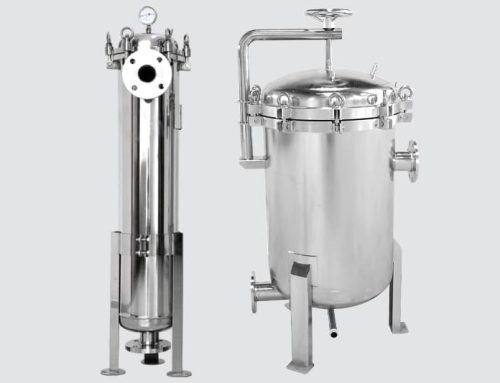
1. Top-entry bag filter
Design features:
- Gravity-assisted filtration: the liquid enters from the top and flows out from the bottom (top-in-bottom-out), avoiding turbulence interference and increasing the utilization rate of filter bag by more than 30%.
- High-pressure resistance: With integral casting top cover and bolt fastening design, the maximum pressure resistance can reach 2.0MPa, which is suitable for high-precision filtration scenarios such as chemical industry and pharmaceutical industry.
- Optimized sealing: the top cover directly compacts the filter bag, the side leakage rate is <0.01%, and the 316L stainless steel material can meet the requirements of FDA food grade certification.
Applicable scenarios: high-precision (0.5μm), high-viscosity liquids (e.g. resin, glue) and frequent replacement of filter bags.

2. Side-entry bag filter
Design features:
- Pipeline adaptability: Side inlet design (side inlet and bottom outlet) supports pipeline connection in any direction, with better spatial adaptability.
- Low pressure loss structure: flared inlet pressure separation design, pressure loss reduced by 15% compared with the top entry type, suitable for large flow rate (45m³/h) and high viscosity liquids (e.g. latex, syrup).
- Convenient maintenance: Flip-top design, no need to dismantle the pipeline to replace the filter bag, shortening the time consuming to less than 5 minutes.
Applicable scenarios: food and beverage, paint industry and medium precision (1-50μm) filtration requiring quick maintenance.
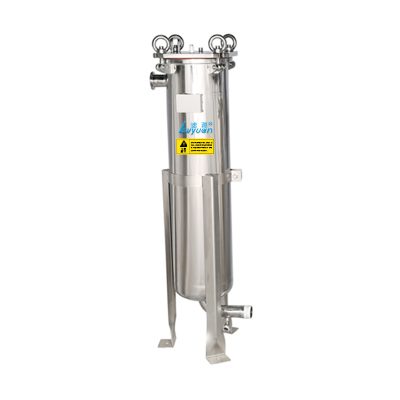
3. Multi-bag bag filter
Design features:
- High flow rate processing: with multiple bags connected in parallel (2-24 bags), the flow rate of a single machine can reach 1000m³/h, and the dirt holding capacity is increased by 3-5 times.
- Modular design: support cylinder-assisted opening, replacement of filter bags for models with more than 12 bags requires only one person to operate, and maintenance efficiency is increased by 40%.
- Material diversity: PTFE filter bag (260℃ high temperature resistance) or biodegradable PP material, suitable for corrosive liquids and environmental protection needs.
Applicable scenarios: industrial wastewater treatment, cooling circulatory system and petrochemical high flow coarse filtration (50-600μm).

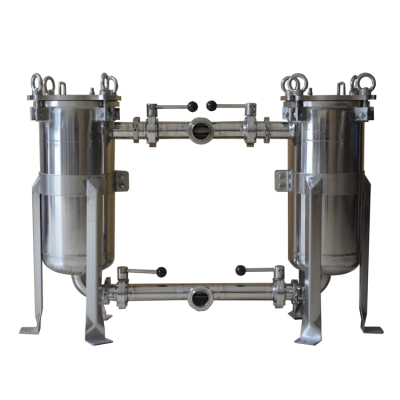
4. Duplex bag filter
Design features:
- Zero downtime switching: double cylinders are connected in parallel structure, and operation/standby unit switching is realized through three-way ball valve to guarantee continuous production.
- Safety redundancy: Built-in differential pressure gauge (threshold 0.4MPa) and pressure relief valve to prevent the risk of bag bursting, complying with ASME BPE standard.
- Customized configuration: optional jacket insulation (steam/thermal oil) and ring bolt locking, suitable for -20℃ to 150℃ working conditions.
Applicable scenarios: pharmaceutical aseptic filling, food processing and fine chemicals where critical processes cannot be interrupted.
Comparison table of core parameters
| Type | Filtration Accuracy (μm) | Maximum Flow Rate (m³/h) | Pressure Resistance (MPa) | Typical Industry Application |
|---|---|---|---|---|
| Top Entry | 0.5-50 | 260 | 2.0 | Pharmaceutical, High Precision Chemical |
| Side Entry | 1-200 | 45 | 1.6 | Food, Coatings, Latex |
| Multi-Bag | 5-600 | 1000 | 1.0 | Industrial waste water, petroleum refining |
| Duplex | 0.5-100 | 90 | 1.5 | Biopharmaceutical, aseptic filling |
V. 10 key factors for bag filter selection
- particle characteristics
- Particle size distribution: the accuracy of the selected filter bag needs to be 20% smaller than the target particles (e.g., 40μm filter bag is required to retain 50μm particles).
- Particle morphology: crystalline particles need to use monofilament woven filter bags (absolute precision), amorphous particles can be needle felt (nominal precision).
- Process conditions
- Temperature: PP material is suitable for ≤80℃, PTFE can withstand high temperature of 260℃.
- Pressure: Side-entry filters can be pressurized up to 16 bar, top-entry usually ≤10 bar.
- Material compatibility
- Chemical corrosion: Nylon (NMO) is excellent in alkali resistance, PTFE is resistant to strong acid and alkali.
- Economic configuration
- Filter bag life: high turbidity water choose long life filter bag (such as meltblown process filter bag life increased by 50%).
- Maintenance cost: multi-bag filter can reduce downtime loss by replacing filter bags in batches.
VI. Industrial application cases of bag filter
- electronics industry: used for ultra-pure water pre-filtration, retaining ≥ 1μm particles, to protect the reverse osmosis membrane life (cases show that the membrane life is extended by 40%). 2. food and beverage: beer brewing process.
- food and beverage: remove yeast residue in beer brewing, using 316L stainless steel shell to ensure food safety.
- municipal water treatment: pre-treatment stage to remove river sediment, reduce subsequent chemical dosage by 20%.
VII. Authoritative data and industry standards
- Filtration efficiency test: according to ISO 16889 standard, the retention rate of needle felt filter bag for 10μm particles ≥ 99.5%.
- Environmental protection certification: food grade filter bags need to pass the FDA 21 CFR and EU 10/2011 certification.
VIII. Maintenance and optimization strategy
- Filter bag replacement signal: Differential pressure gauge shows ≥0.5bar or turbidity of the effluent water rises by 10%. 2.
- Cleaning technology: ultrasonic cleaning can restore more than 90% of the filter bag flux.
- Intelligent monitoring: add IoT sensors to realize real-time warning of differential pressure and flow, and reduce maintenance cost by 25%.
IX. Future trends and technological innovations
- Nano-coated filter bag: improve surface hydrophobicity, reduce organic matter adhesion.
- Biodegradable materials: Bio-based PP filter bags reduce carbon footprint by 30% (pilot project data).
X. Conclusion
Bag filter has become the core equipment in the field of water treatment by virtue of its high efficiency, economy and easy maintenance. Selection needs to synthesize the particle characteristics, process conditions and cost factors, and through intelligent monitoring to extend the life of the equipment. With the application of new materials and Internet of Things technology, bag filters will play a greater value in environmental protection and Industry 4.0.